
A visit to Eyam in Derbyshire – the plague village. There can’t be many greater selfless acts than those of the residents of Eyam in the 17th century. Faced with almost certain death they closed their entire village down, prepared to succumb to the horrors of the Black Death and prevent it spreading to nearby communities. Today Eyam in Derbyshire is eerie, beautiful and a fascinating trip out.
Table of Contents
How Eyam in Derbyshire got the plague
In 1665 an Eyam tailor received a bundle of material from London, ready to create some garments from.
His assistant, George Viccars opened up the damp, smelly bundle and carefully hung each piece of cloth in front of the fire to dry out.
What he couldn’t have realised was the material contained a deadly secret. Teams of fleas, all infected with the bubonic plague which was ravaging London.
George became the first victim of the plague in Eyam and a visit to the house where he died, the painful, long, lingering death, is haunting.
Who died – A visit to Eyam in Derbyshire – the plague village
When you read the plaque outside which tells you of the other members of his household to catch the disease from him it is sobering.
Mary Hadfield, formerly Cooper, lived here with her two sons, Edward and Jonathan, her new husband Alexander Hadfield, and an employed hand, George Viccars. George Viccars, the first plague victim, died on the 7th September 1665. Edward Cooper, aged 4, died on the 22nd September 1665. Jonathan Cooper, aged 12, died on the 2nd October 1665. Alexander Hadfield died on the 3rd August 1666. Mary alone survived but lost 19 relatives.

Soon the deaths spread as neighbours and friends became sick. The Black Death crept its way through the village.
Today you can walk through the main street, which is absolutely beautiful, and pause at the houses and the sad stories they have to tell.
The Hawksworth Family – Peter, the 3rd victim, died on 23rd September 1665. Humphrey, aged 15 months, their son, died on 17th October 1665. Jane was the sole survivor in the household. All together, including her inlaws, she lost 25 relatives.

In any other setting these homes would just be beautiful to gaze upon. However this quintessentially English village which is picture perfect, just unfolds horror with every step.
Rose Cottage. Nine members of the Thorpe family lived here. They all died.
Thomas Thorpe, died 26 September, 1665
Mary, his daughter, 30th September 1665
Elizabeth, his wife, died 1st October 1665 Thomas, his son, died 20th December 1665 Alice, his daughter, died 15th April 1666 Robert, his son, died 2nd May 1666 William, his son, died 2nd May 1666 William and Mary Thorpe the parents of Thomas senior died 1666

The selfless act of the residents to prevent The Black Death from spreading
What makes Eyam particularly remarkable was the decision of the villagers to essentially seal themselves off.
They left markers around the boundary warning unsuspecting travellers to come no closer. And they had an agreement with another village that food would be delivered to the periphery of the area and then collected.
By so doing they stopped the spread of the plague to other Derbyshire villages and beyond.
The plague was highly contagious and had a very low survival rate in the 17th century.
Within a week of being around someone carrying the disease victims would start to develop flu like symptoms before painful red blotches would appear all over their skin.
Death would come quickly thereafter and those days of incubation meant it was easily passed amongst friends without realising it.
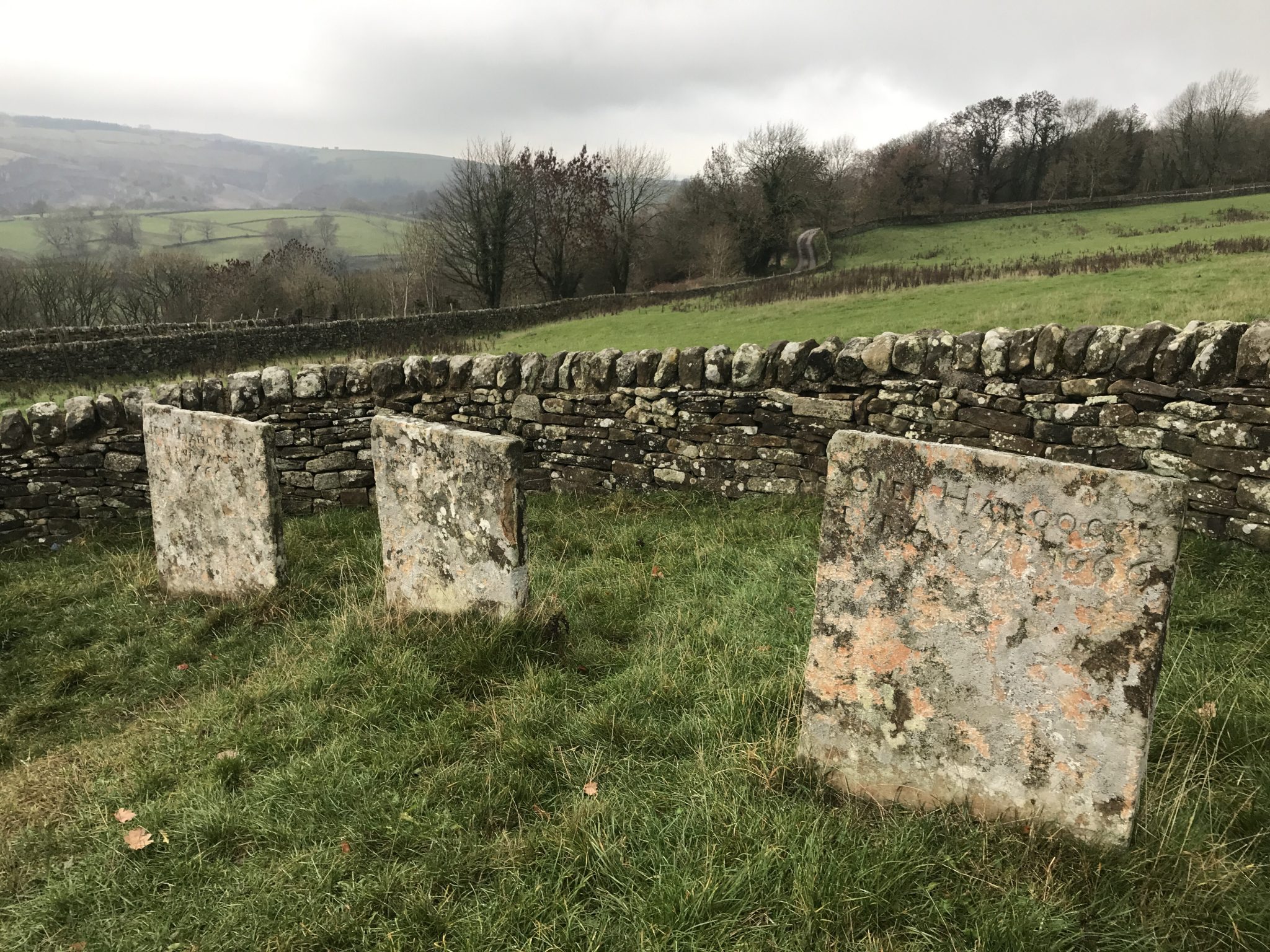
It is hard to imagine the indescribable pain of Elizabeth Hancock who buried her husband and six children, by herself.
She managed to drag their bodies to open land, near to her farm, and bury them when they died, all within eight days of one another.
Today they are memorialised by a plot which is maintained by the National Trust.
By the 1st November 1666 the Plague left Eyam.
The selfless act of the villagers, to quarantine themselves and face an almost certain death was to save countless others.
So intense was the Black Death in Eyam that the rate of death of villagers was higher than those in London.

Top tips for visiting Eyam in Derbyshire – the plague village
Park up in the car park behind the tourist information building. This is the perfect place to walk from here, through the main old High Street to look at all the houses.
The little cafe in the centre, The Coolstone is perfect for stopping for soup and jacket potatoes. We received the friendliest of welcomes here and it’s a great spot to start or end your walk through the village.

If you’re looking to visit the Hancock graves, also known as the Riley graves (after their farm) it is a fair distance out of the village so worth driving up to.
Life still goes on in Eyam, when we visited there was a little craft market happening. And all of these homes that we looked upon with horror as we read the plaques attached to them had families living within them today.
It’s a beautiful village that showed great bravery in the midst of absolute terror. You can almost touch the history in Eyam, it’s a fascinating visit.
Don’t forget to check out our top things to do in the Peak District nearby.



This made me cry so much! Those poor people x
It’s terrible isn’t it? Unimaginable. I think seeing the dates and how quickly each family member died, one after another, is so awful.
I have a trip planned here over Easter when we’re staying at Darwin Forest – it looks fascinating.
We visited Eyam back in October, it really is a very touching and interesting place. I love the stained glass window in the church depicting the story. You can also walk out to the boundary stone which separated the village from the next, where neighbouring villagers left provisions. The kids were fascinated by the story. Amazing place.
I’m so pleased to hear you enjoyed it there too. It’s so interesting isn’t it? I’d love to return.
What a fascinating day out – and what heart breaking stories. It’s terrifying to think how quickly the plague could wipe out entire communities let alone families. It’s lovely to think their sacrifice is still remembered though .